Reading Comprehension Practice: A 5-Minute Daily Guide
Start effective reading comprehension practice at home. This guide offers fun, 5-minute daily routines for kids 6-12, turning practice into a habit they love.

Your child reads the words smoothly. You ask, “What was that about?” and you get a shrug, a guess, or that blank look every parent knows.
That moment worries people more than slow reading ever does. And it should. Reading isn't only saying the words correctly. It's holding meaning in your head, following what matters, noticing clues, and making sense of the whole piece.
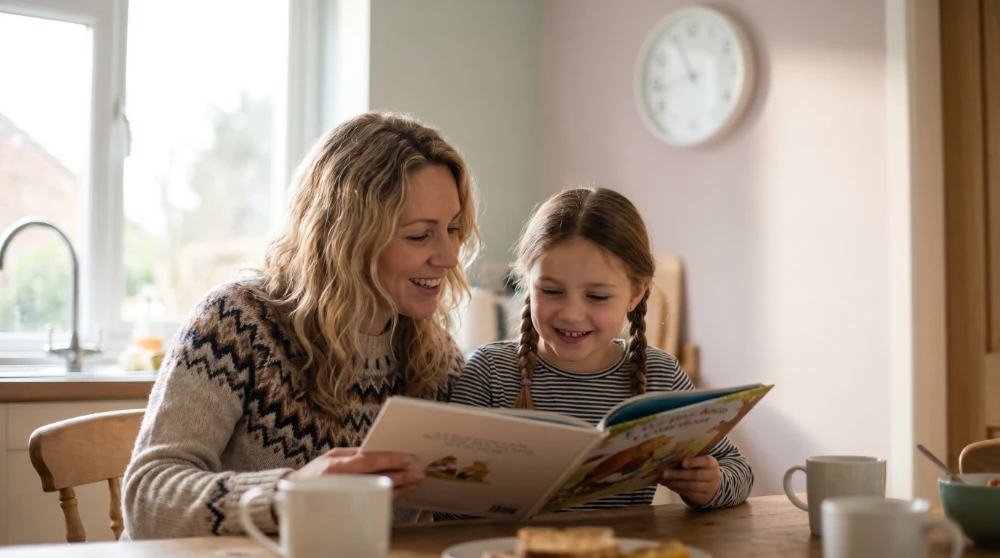
After many years in primary classrooms, from children just starting their reading journey to older pupils working through trickier texts and sneaky comprehension questions, I've learned something simple.
Children rarely build strong comprehension through pressure, long drills, or piles of worksheets. They build it through short, steady, playful practice that feels doable on an ordinary day.
I've seen that change happen with children like Jasmijn, a young student who didn't want to pick up books on her own. We practised with short texts every day. No heavy session. No battle. Just a small routine. Over time, the resistance dropped. Then the confidence came. Then something even better happened. She started wanting to read.
That's the shift parents are usually looking for. Not just correct answers, but a child who starts to understand, remember, and enjoy what they read.
Table of Contents
- From Reading Words to Understanding Worlds
- Why 5-Minute Sessions Outperform Long Reading Drills
- Your Blueprint for a 5-Minute Practice Session
- The Art of Asking Questions That Build Brains
- How to Help When Your Child Gets Stuck
- Turning Daily Practice into Lasting Confidence
From Reading Words to Understanding Worlds
You hear your child read a page out loud while you clear the tea things. The reading sounds smooth. Then you ask, “So what happened?” and you get a shrug, or a guess that does not fit the story at all.
That moment catches many parents off guard. A child may read the words accurately and still miss the meaning. In school, that gap shows up fast once texts get longer and questions ask for more than a single fact. Children are expected to hold onto the main idea, notice important details, work out word meanings from context, and explain what the writer is really saying.
The problem usually isn't laziness
In my experience, children rarely struggle because they are not trying. More often, they are using so much effort to get through the text that there is not much attention left for understanding it.
Some lose the thread halfway through a paragraph. Some rush to answer before they have pictured what they read. Some can decode neatly but do not yet stop and connect one sentence to the next. That is why a child can sound like a strong reader and still need direct help with comprehension.
For parents, this can feel confusing and even a bit discouraging. It helps to know that the answer is usually not more pressure.
I do not start with longer passages or another stack of worksheets. I start with something a child can manage and finish well in one sitting. A short text. One or two thoughtful questions. Five calm minutes at the table, in the car, or on the sofa before bed. Done daily, that small routine gives a child repeated practice in making meaning, without turning reading into a battle.
What changed for children like Jasmijn
Jasmijn did not need a pep talk about concentrating harder. She needed a routine that felt easy to begin and light enough to repeat every day. Short texts worked because she could hold the whole idea in her head. Playful prompts worked because they gave her a reason to pay attention.
With her, I might ask, “What is one thing we know for sure?” or “Which part gave you that idea?” On other days, we turned it into a quick challenge. Pick the best title. Find one clue about how the character feels. Tell the story in one sentence before the timer ends.
That is the heart of effective practice for reading comprehension at home. Keep the starting point small. Keep it interesting. Keep it regular enough that your child expects it, and short enough that neither of you dreads it.
When children meet success in these little bursts, they begin to see reading as something they can understand, not just something they have to get through.
Why 5-Minute Sessions Outperform Long Reading Drills
It is 6:40 p.m. Dinner is half-cleared, someone still needs a bath, and your child is already tired. That is exactly when many parents try to squeeze in “proper” reading practice, then wonder why it turns into sighing, guessing, or tears. In real homes, the routine that works is usually the one that is short enough to start without a fight.
Five minutes sounds small. For comprehension practice, that is often its strength.

Short sessions protect attention
Comprehension is not the same as saying the words correctly. A child has to hold ideas in mind, connect details, notice clues, and explain their thinking. That is demanding work, especially after a full school day.
In my experience, once a session stretches too long, the quality drops before parents realise it. A child may still be reading aloud, but the thinking has gone. They start to rush. They give random answers. They look as if they are working, while understanding slips away.
A short session helps you catch your child while their mind is still fresh enough to think.
Repetition beats intensity at home
Parents often assume a longer session must be more effective because it covers more. Sometimes it covers more lines on the page. It does not always build more understanding.
What helps most at home is frequency. Five playful minutes done most days gives a child many chances to practise the same mental habits: pausing, noticing, predicting, checking, and putting an idea into words. Those small repetitions are what make comprehension feel familiar instead of heavy.
This is also why worksheet marathons tend to fizzle out. They ask for too much stamina at once. A brief routine asks for less, so families keep doing it. If you want ideas that keep that routine light, these fun ways to practise reading comprehension at home without worksheets are a good fit for busy evenings.
Short practice lowers resistance
Children behave differently when they know the finish line is close.
If I say, “We're doing twenty minutes,” many children brace themselves before they even begin. If I say, “Let's read this short bit and answer one quick question,” they are far more willing to have a go. That matters because willingness is not a bonus in comprehension work. It affects the whole session.
A five-minute routine gives you a few practical advantages:
- You get a better start. Children are more likely to begin promptly when the task feels manageable.
- You can keep the tone warm. It is easier to stay patient for five focused minutes than for a dragged-out half hour.
- Your child ends with energy left. Stopping before frustration peaks helps protect confidence.
- Tomorrow feels doable. A small success is much easier to repeat than a long struggle.
Longer is not automatically better
More time only helps when the child is reading, thinking, and making sense of the text. If the passage is too hard, if the questions are vague, or if your child is already overloaded, adding fifteen more minutes usually adds more fatigue.
I would rather see a child read one short paragraph, answer one good question, and feel successful than push through three pages with very little understanding. That is the key trade-off. Long drills can look serious and productive to adults. Short daily sessions often do more because they protect attention, reduce friction, and make consistency possible.
And consistency is what turns practice into habit.
Your Blueprint for a 5-Minute Practice Session
The easiest five-minute sessions usually happen in ordinary moments. A child curls up on the sofa after tea. You pull out a short paragraph about sharks, a joke book, or a page from a familiar story. You read, ask one thoughtful question, and stop while things are still going well. That is often enough.

Start with the right kind of text
Choose something short enough to finish without a battle and interesting enough that your child wants to know what happens or what the facts mean. In my experience, interest buys attention. Attention makes comprehension much easier.
A good choice might be:
- a short story paragraph
- a page from a comic
- a football report
- a fact card about animals
- a funny riddle or advert
- a recipe step
- a child-friendly news snippet
Three checks help:
- Keep it short. Finishing matters more than tackling a worthy text that feels heavy.
- Keep it clear. One main idea is better than a text packed with too many characters or twists.
- Keep it within reach. A little challenge is helpful. Total overload is not.
If you want fresh ideas that feel playful rather than worksheet-heavy, this guide to fun ways to practise reading comprehension at home is a useful place to start.
What the five minutes can look like
A simple routine helps children settle because they know what is coming. I would use something like this.
-
Pick the spot
Sit somewhere easy. The kitchen table works. So does the sofa, the car before school, or the edge of the bed at night. If setting up feels fussy, the habit usually fades. -
Read a small chunk
One paragraph is plenty. Your child can read it alone, read with you, or listen first and then reread. The best option is the one that keeps them engaged. -
Check the gist
Ask one broad question: “What is this mostly about?” or “What happened here?” This quickly shows whether the basic meaning is there. -
Ask one thinking question
Keep it focused: “Why do you think she hid the letter?” or “Which word tells us it was raining hard?” One strong question does more than a page of rushed ones. -
Finish with a clear win
Name the success you saw. “You noticed that clue.” “You fixed your answer by looking back.” “You explained that really clearly.” Children repeat what feels manageable and successful.
Model calm thinking out loud
When a child gets stuck, it helps to hear how a steady reader works through confusion. Say what you are noticing and what you are checking.
For example: “I am going back to that sentence because I missed an important clue.” Or, “This word makes me think the character is worried.” That kind of modelling shows your child that good readers do not guess wildly. They slow down, reread, and use the text.
A short demonstration usually works better than a long explanation.
Here's a useful example of how calm support can look during practice:
Keep it light enough to repeat tomorrow
Some children like a pencil in hand. Others do better if the whole thing feels more like a quick chat. Both can work. A key indicator is simple. Can your family do it again tomorrow without groaning?
That is why I prefer short, playful sessions over long drills at home. Five calm minutes leaves room for success, and success is what helps a reading habit last.
If your child finishes feeling capable, the session has done its job.
The Art of Asking Questions That Build Brains
Your child closes the book, and you ask, “What happened?” They shrug and give you one thin sentence. That does not mean they understood nothing. It usually means the question was too broad.
Children's reading comprehension grows when your questions guide them from spotting information, to explaining clues, to sharing a view of their own. In a short five-minute routine, that matters. A few well-chosen questions can wake up thinking far better than a long sheet of mixed tasks.
Three question types that work well
I use three simple kinds of questions at home and in the classroom.
Text Detective questions keep the child close to the page. They ask the reader to find key details, notice the main idea, or work out a word from the sentence around it.
Reading Between the Lines questions ask the child to infer. The answer is not written plainly, but the clues are there.
Big Thinker questions ask for a judgement, a connection, or a reasoned opinion. These are especially useful with older children, but younger ones can do them too when the question is concrete.
One strong question, asked slowly, usually does more good than five rushed ones.
Playful Question Types for Reading Comprehension
| Question Type | Focus for Ages 6-8 | Focus for Ages 9-12 |
|---|---|---|
| Literal | Who was in the story? What happened first? Which detail tells us where they are? | What is the main idea? Which detail supports that idea? What does this word mean in this sentence? |
| Inferential | How do you think the character feels? What clue helped you decide? What might happen next? | Why did the character choose that? What can you infer from this paragraph? Which clues point to the author's message? |
| Evaluative | Was that a kind choice? What would you do? Did this remind you of something you know? | Do you agree with the decision in the text? Was the argument convincing? What would you change and why? |
How to make questions feel like conversation
Children answer more freely when the question sounds like interest, not a test. Tone matters as much as the question itself.
Try shifts like these:
- Invite noticing. Say, “Show me the part that helped you think that.”
- Ask for proof. Say, “What in the text makes you say that?”
- Stay with a good answer a little longer. Ask, “Can you tell me a bit more?”
- Keep it playful. Try, “If you were the detective, what clue would you point to first?”
That style helps because it teaches the habits good readers use. They look for the main idea. They connect details. They notice vocabulary in context. They consider the author's purpose. In a five-minute session, you do not need to cover all of that. You just need one useful thinking move, repeated often enough that it becomes familiar.
I have found that parents often ask better questions when they stop aiming for the “right” school-style prompt and start having a focused conversation instead.
Keep the question matched to the child
A six-year-old may give a brilliant answer by pointing to one sentence and saying, “This bit shows he is scared.” That counts. A ten-year-old can usually go further and explain how two clues fit together.
Match the question to the child in front of you. If the text is hard, keep the question narrow. If the child answers easily, add one follow-up that stretches thinking.
For children who read aloud smoothly but struggle to explain what they have read, this guide on why some children can read well but still struggle to understand the text can help you spot what is really getting in the way.
That is the sweet spot. Short, doable, and just challenging enough to build confidence tomorrow as well as today.
How to Help When Your Child Gets Stuck
Some children freeze. Some guess. Some say “I don't know” before they've even looked back. That doesn't mean the session is failing. It usually means the child needs less pressure and more structure.
Back up before you push forward
My favourite classroom move is very simple. Go back a little in the text. Read the previous sentence or short section again together. Let the child hear the context one more time before trying the question again.
That small step often reveals the answer because the child reconnects with the thread of meaning. Many comprehension errors happen because the reader has lost the flow, not because they are incapable.

Turn guessing into evidence hunting
If your child blurts out random answers, change the role. Don't say, “No, try again.” Say, “Be a text detective. Show me where you found that.”
That small language shift helps because it moves the child away from performance and toward proof. You're teaching a habit. Go back. Check the text. Use a clue.
For parents dealing with a fluent reader who still doesn't understand much, this article on why some children can read well but not understand what they read can help make sense of what's going on.
Choose a just-right level
One analysis found that students showed the greatest gains when they averaged 85% to 95% on comprehension quizzes, while students at 75% or higher still made accelerated growth. The same analysis found that when literal comprehension was low, increasing reading time from under 15 minutes to over 30 minutes had almost no effect on growth, according to this analysis of reading growth and literal comprehension.
That's a useful guide for home practice. If your child gets nearly everything wrong, don't just make them read longer. Make the text easier, shorten the passage, or support the first read more closely.
When a child is stuck, reduce the load first. Don't increase the pressure first.
What doesn't help much
A few common habits sound useful but often backfire:
- Long lectures after wrong answers. Children stop listening fast when the correction is longer than the task.
- Too many questions in a row. This turns reading into interrogation.
- Texts that are far too hard. Frustration is not the same as challenge.
Good troubleshooting is usually gentle. Re-read. Narrow the question. Find the clue. End on one success.
Turning Daily Practice into Lasting Confidence
It often starts with a small evening moment. Your child finishes a short passage, shrugs, and gives a one-word answer. A few weeks later, with the same 5-minute routine, that answer turns into, “I think she did that because she was worried.” That is the kind of progress that lasts.
Confidence in reading comprehension grows from success your child can feel and repeat. Short, playful daily practice gives them regular chances to understand something, say it out loud, and try again the next day without the weight of a long worksheet hanging over them.
As noted earlier, strong comprehension teaching can make a meaningful difference over a school year. At home, that usually looks less dramatic than parents expect. It shows up in steady signs that are easy to miss if you are only looking for perfect answers.
Look for changes like these. Your child answers in a fuller sentence. Your child checks the text again before guessing. Your child starts noticing motives, feelings, or patterns in the story. One of my favourite signs is simple. Reading stops feeling like a battle.
That is why consistency matters more than intensity for most families. Five calm minutes after school, at breakfast, or before bed usually works better than one long session that leaves everyone tired. Children build trust in their own thinking by doing a manageable task often enough to feel successful.
If you want help setting that rhythm, the 7-day reading challenge for families offers a simple way to make daily practice stick. ReadLab is one example of a tool for children aged 6 to 12 who can decode the words but still need short, level-based comprehension practice with progress tracking.
If you want reading practice that feels manageable for both you and your child, ReadLab offers short, playful comprehension sessions built around real stories, level-adjusted questions, and a routine that fits into ordinary family life. It's designed for the child who can read the words but still needs help turning those words into meaning.